About us
A Treasury source said (Jan 2025): “We’re always interested in hearing ideas for making A Treasury source said (Jan 2025): “We’re always interested in hearing ideas for mak our tax regime more attractive to talented entrepreneurs an • Jonathan Reynolds, business secretary, said (Jan 2025): “We welcome people coming to Jonathan Reynoldsbusiness secretarysaid (Jan 2025): “We welcome people FIFB warns that time is critical, as people are continuing to leave. In the Chancellor's budget statement in Parliament on October 30, 2024, she explicitly stated that there would be an international competitive regime in lieu of the resident Non-Dom scheme. The Non-Dom regime needed to be reformed and did not raise enough money for the UK economy but a new proposal that is internationally competitive can be both fair and keep prosperity creators in Britain.
Join us now
Stay up to date on relevant news and developments.
The challenge – reforming the non-dom to be internationally competitive regime
The investment community must look to work with the Government as part of its reforms, providing robust policy proposals which deliver for the taxpayer, while also maintaining Britain’s international reputation as a destination for inward investment.
The Government has introduced the following measures:
· Repealed the remittance basis of taxation for non-dom individuals and replaced it with the four-year Foreign Income and Gains regime for those moving to the UK from abroad.
· Changed the inheritance tax (IHT) rules, so that individuals moving to the UK from abroad will come within the scope of IHT on their non-UK assets after ten tax years of UK residence, and ten years after leaving the UK.
FIFB is concerned that these measures will have a number of unintended consequences, which will lead to long-lasting damage for the UK:
· The new “FIG regime” is too short and uncompetitive when compared with other European offers, such as Italy, to entice foreign investment to the UK for internationally mobile investors.
· Our analysis has shown that the FIG regime will not raise significant revenue for the UK. The current policy changes do not incentivise current non-doms to stay in the UK, nor does it act as an attractive international regime. As such, the projected revenues for the Exchequer are significantly inflated.
FIFB’s deep research base found key red lines that former non-doms, foreign investors, could not accept.
- UK IHT on non-UK assets was seen as the redline – 83% of survey respondents identified this.
- Oxford Economics’ analysis estimates that the reforms to the regime could cost the Exchequer up to £1 billion in lost tax in 2029/30. This figure stands in stark contrast to the OBR’s estimate of fiscal gain of around £3 billion per annum.
- On average foreign investors invested £118 million each into the economy.
- Foreign investors paid £8.9 billion in taxes last year.
- On average, respondents paid £800,000 in UK VAT in 2023/24 and £890,000 in stamp duty over the five-year period to 2023/24.
FIFB is concerned that these changes have a number of unintended consequences which will lead to long-lasting damage for the UK:
- The new “FIG regime” is too short and uncompetitive when compared with other European offers, such as Italy to entice foreign investment to the UK for Internationally mobile investors.
- Our analysis has shown that the FIG regime will not raise significant revenue for the UK. The current policy changes do not incentivise current non-doms to stay in the UK, nor do they act as an attractive international regime. As such, the projected revenues for the Exchequer are significantly inflated.
Evidence base – report from Oxford Economics
Foreign Investors for Britain commissioned Oxford Economics (OE) to conduct an in-depth analysis of the Government’s reforms.
OE has directly surveyed 72 non-doms and 42 tax advisors (who represent 952 non-dom clients), in what is the largest and most comprehensive study of the non-dom community. The surveys gather insights on how non-doms would respond to the changes to the regimes for both foreign income and gains (FIG) and inheritance tax (IHT).
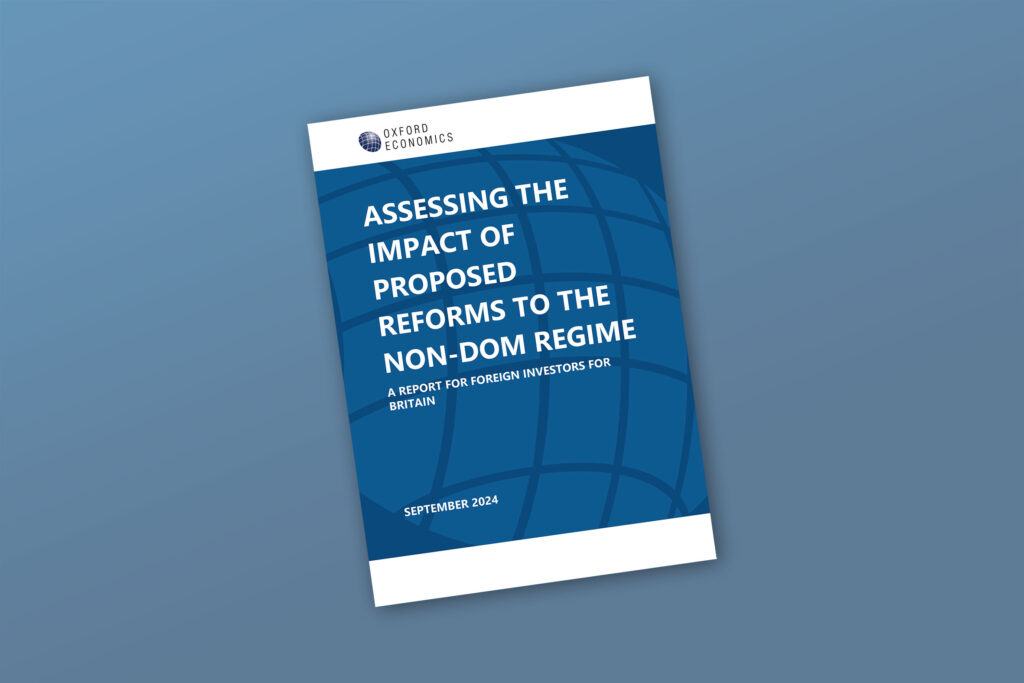
As part of their study, OE has identified:
Inheritance Tax (IHT) Concerns:
83% of non-doms identified global IHT on their assets as a major reason they might leave the UK. Tax advisors noted that IHT changes are the primary reason for potential emigration, with 57% citing this as a key concern for investors and 55% for entrepreneurs.
Impact of Proposed Reforms:
67% of non-doms using the remittance basis indicated they would not have moved to the UK if the proposed reforms had been in place. Additionally, over two-thirds of advisors reported a reduction of more than 50% in new clients since the March 2024 Budget announcement.
Economic Contribution:
On average, non-doms surveyed have invested £118 million each into the UK economy. However, 96% of respondents indicated they would reduce their investments in the UK if they decided to leave. What is more, the average non-dom contribution towards philanthropy was £5.8 million, a significant social contribution which is not captured by existing studies, and is now at risk under the current regime.
Exchequer impact:
Modelling, based on the survey findings, shows that instead of raising additional tax revenue, the reforms could cost £0.9bn in 2029/30.
The solution a Global Investor Visa that is internationally competitive - raising more revenue but retaining investors
FIFB has consistently argued that it’s vital that the UK protect the investments made by non-doms and retain the country’s ability to compete internationally for new wealth creators. As such, we propose that a new, Global Investor Visa that would bolster the UK’s international competitiveness and deliver more significant returns to the Exchequer. This could be equivalent to Italy’s scheme with an added premium for being in Britain and could be flat rate or tiered.

Global Investor Visa Headline Terms:
Annual fee: £200,000
Minimum UK investment: £2.5 million (first year)
Duration: up to 15 years (minimum five)
Exemption from UK tax on foreign income, gains, and Inheritance Tax on non-UK assets.
Trust Treatment & Fairness:
Pre-October 2024 offshore trusts retain excluded property status.
New trusts fixed IHT treatment at settlement; exit charge abolished when settlor ceases to be a long-term resident.
UK-source income and gains remain fully taxable, with full due diligence and anti-abuse protocols.
Economic Impact:
Each participant would contribute a minimum £3.5 million to the UK economy over five years. With 50,000 investors, this could generate more than £225 billion over a decade, alongside significant boosts to jobs, innovation, and philanthropy.
Delivering this policy change would deliver significant benefits for the UK as a whole, including:
- Protecting the UK’s international competitiveness: A substantial proportion of non-doms have left or are making plans to leave the UK but have not yet done so. The announcement of the Global Investor Visa which existing non-doms could switch into would have a strong stabilising effect, and would stem the exodus from the UK of international wealth creators.
- Maintain the UK as a destination for investment: Many foreign domiciled individuals are in principle keen to move to the UK, but have been deterred by the reforms. Our proposed Global Investor Visa would put the UK firmly back on the table as a viable, attractive country of residence for these individuals.
- Deliver for the taxpayer: Each participant would contribute a minimum £3.5 million to the UK economy over five years. With 50,000 investors, this could generate more than £225 billion over a decade, alongside significant boosts to jobs, innovation, and philanthropy.
- Drive economic growth across our nation: Incentivising leading business and industry figures to the UK as residents unlocks a magnitude of opportunities for UK plc, creating long-term employment opportunities and new streams of private sector capital.